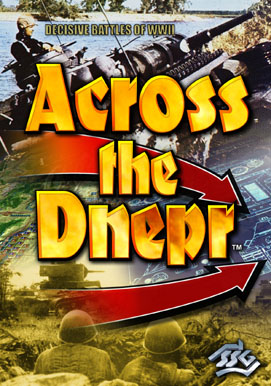
| Across the Dnepr is a new campaign scenario for the Korsun
Pocket game. It recreates the events of July 1941, when Operation Barbarossa
was in full swing and German armies were poised to enter the heartland
of Russia. Army Group Center is aimed at the vital objective of Smolensk,
located on the Dnepr river and defending the shortest route to Moscow.
Although their frontier armies had been overwhelmed, the Red Army was
far from finished. Remnant forces kept fighting and new formations arrived
on the battlefield, ordered to make immediate, if somewhat suicidal, counterattacks.
The result is a swirling melee as the two armies clash head on, and notions
of flank security are abandoned in a desperate fight for survival.
Each Russian casualty, whether man or machine, can ultimately be replaced
from Russia’s vast reserve, reserves the Germans simply don’t
have. Each day that the Germans are delayed at Smolensk is another day
purchased for the defence of Moscow and the rest of Russia.
GAME FEATURES
24 day campaign length scenario
Huge battlefield with superb map graphics
Special rules for Soviet entrenchment
Improved AI scripting
117 Soviet divisions confront 35 German divisions
|
|
AVAILABILITY
Across the Dnepr is available via download only. Check out www.matrixgames.com
for purchase details.
Across the Dnepr requires V1.1 or later of Korsun Pocket to
play.
SCREEN SHOTS
Click here for Screen Shots from Across the Dnepr.
HISTORY
At the time that Across the Dnepr starts, German morale is very high. The
initial attacks have yielded stunning successes, with Russian formations brushed
aside and often herded into large pockets, yielding gratifying numbers of prisoners,
and huge amounts of captured weapons and other war material.
Yet to be fully realised are the strain that even these early victories have
put on the German war machine. Some Russian units have defended stubbornly,
others have attempted break-outs from pockets or counterattacked. The terrain
itself and the primitive nature of Russian infrastructure also conspired to
aid the defender.
Also just becoming clear to the Germans was the sheer size of the Red Army,
almost twice the size of optimistic pre-war estimates. Yet none of these factors
could disguise the fact that the Wehrmacht formations were operationally far
superior to the Red Army defenders, and that Smolensk was doomed to fall. The
issue in dispute was the price that Germans would have to pay for its capture,
and they time they would have to take to achieve it.
By the 9th of July, (when the Across the Dnepr scenario starts) 2nd Panzer
Armee was poised to cross the Dnepr and 3rd Panzer Armee was aimed at what remained
of the defences along the Dvina. Soviet defenders at Vitebsk were beaten to
the punch and despite desperate defence it fell quickly. By the 11th, Guderian’s
2nd Panzer Armee had forced its way across the Dnepr and the way to Smolensk
lay open.
The speed of the German attacks, and confusion and sluggishness of the Soviet
response had created the usual pockets, at Mogilev, Vitebsk and elsewhere. By
the 16th July, 3rd Panzer Armee had taken Smolensk from the north, and 2nd Panzer
Armee arrived from the south on the 17th. This pincer move had pocketed over
a dozen Soviet divisions between Orsha and Smolensk, but as the German infantry
had not caught up with the armour, the encirclement was tenuous, and Soviet
formations were able to infiltrate their way out.
The escape of some Soviet formations set off a debate and disagreement in the
German High Command in which a simple question resonated through all levels
of military operations. Should German armour be used for continuos penetration
and disruption of Soviet defences, aiming to cover as much ground as possible,
or should it be diverted to ensure encirclement and defeat of as many Russian
units as possible, and the speedy capture of important cities and economic resources?
The capture of Smolensk had not resolved the battle. Fresh Soviet formations
maintained continuous pressure on the flanks of 2nd Panzer Armee, and inflicted
serious losses on the 10th Panzer Division on 24th July. The Smolensk and Mogilev
pockets were still active, the Mogilev pocket not falling till the 27th of July
and the Smolensk pocket holding out until the 5th of August.
At the time our scenario ends, German forces were approaching Vyasma. Roslavl
and Yel’nya had fallen. At Yel’nya, Soviet counter-attacks at last
paid dividends, and for the first time in the campaign, German infantry divisions
were checked, punished and set back on their heels. Some regiments lost as many
as 1,500 men in a single day.
Notwithstanding the rare successes, the opening months of the war were a disaster
for the Soviet Union. Few divisions had the trucks or horses necessary to move
their heavy equipment, supplies of all kinds were disrupted, and leadership
was poor or non-existent. It is unrealistic to expect the Soviets to be able
to stop the German advance. However, they have a large number of units, though
of very variable quality. The Germans are on a very tight timetable, and a resourceful
Russian player can punish German audacity and win glory for himself!